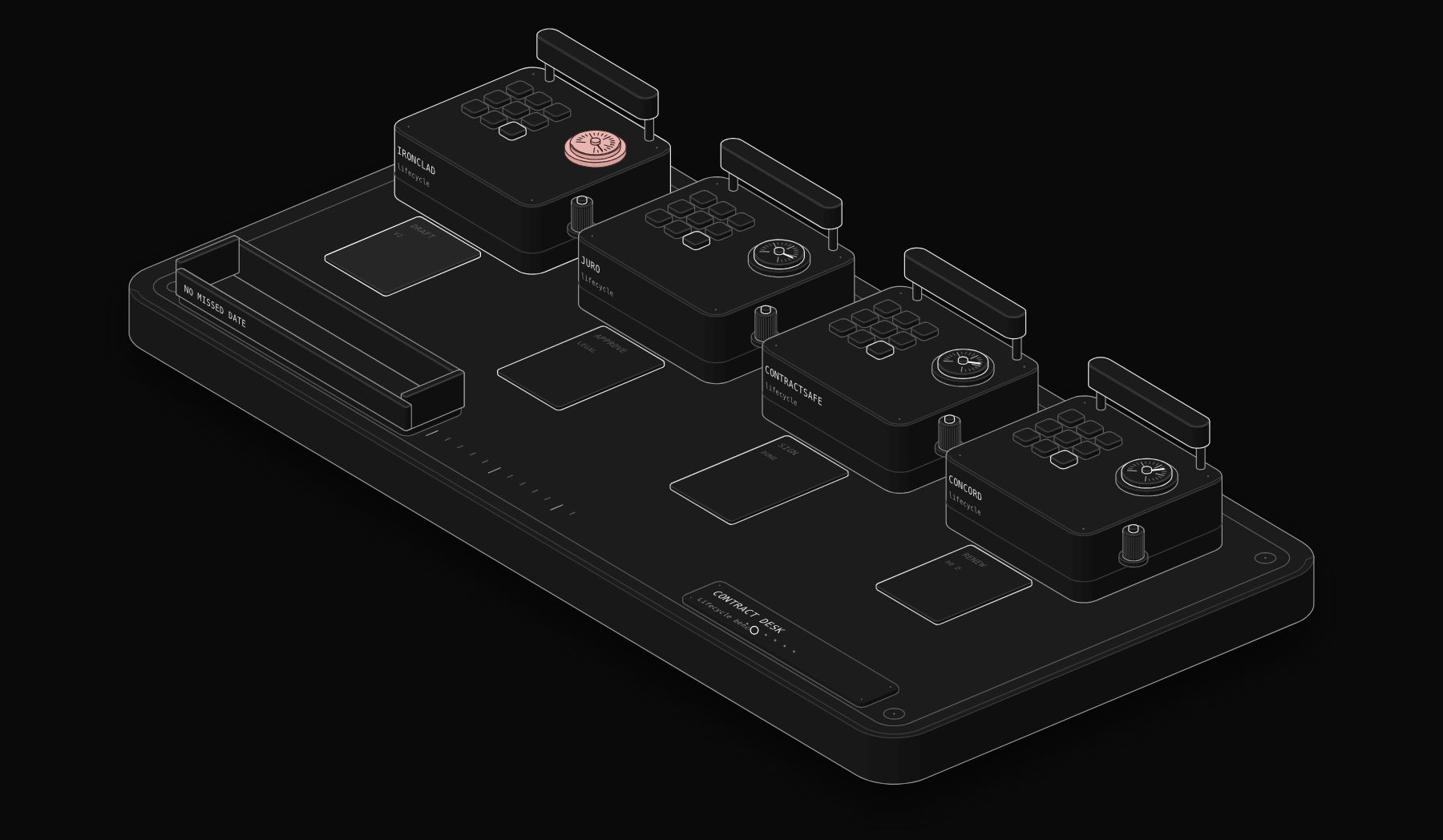
Contract management software exists because contracts do not end at the signature. Renewal dates, notice periods, price increases, obligations and approvals all live inside signed documents that nobody reads again until something goes wrong. This comparison looks at four contract management platforms that cover the range from small teams to enterprise legal departments: Ironclad, Juro, ContractSafe and Concord. Prices were read on the vendors' own pages on November 17, 2026.
In short. Concord is our pick for small and mid-size businesses that want published pricing and a complete workflow (8.0/10), from $499 per month billed annually with 5 users included. ContractSafe (7.9/10) is the best repository for teams that mainly need to store, search and track deadlines, with unlimited users and pricing from $450 per month billed annually. Juro (7.6/10) suits fast-moving businesses that want contracts agreed in the browser without legal in every loop, priced by quote. Ironclad (7.4/10) is the enterprise choice for complex, high-volume contracting across legal, sales, finance and HR, priced by quote.
Signature tools versus contract management
An e-signature tool gets a document signed. Contract management covers the whole lifecycle: request, draft from a template, negotiate, approve, sign, store, then track every date and obligation until renewal or termination. If you only need signatures, our DocuSign vs PandaDoc vs Dropbox Sign comparison is the right starting point. If missed renewals, lost versions or slow approvals are costing you money, read on.
How we score: the PURIST Fit Score
| Criterion | What it measures | Weight |
|---|---|---|
| Lifecycle coverage | Intake, templates, negotiation, approvals, signature, repository, renewals | 25% |
| Repository and tracking | Search, AI extraction, reminders, reporting on obligations | 25% |
| Price transparency and value | Published pricing and real cost for a small team | 25% |
| Automation readiness | API, CRM and storage integrations, webhooks | 25% |
Source: compiled by PURIST (purist.online), November 17, 2026.
The four platforms side by side
| Platform | Lifecycle coverage | Repository and tracking | Price transparency and value | Automation readiness | PURIST Fit Score |
|---|---|---|---|---|---|
| Concord | 8/10 | 8/10 | 8/10 | 8/10 | 8.0/10 |
| ContractSafe | 6.5/10 | 9/10 | 8.5/10 | 7.5/10 | 7.9/10 |
| Juro | 8.5/10 | 7.5/10 | 6/10 | 8.5/10 | 7.6/10 |
| Ironclad | 9.5/10 | 8.5/10 | 4/10 | 9.5/10 | 7.4/10 |
Source: compiled by PURIST (purist.online), November 17, 2026.
These are editorial scores based on published plans and features, not user ratings. Ironclad and Juro score lower on price transparency because they price by quote, which says nothing about whether they are good value for your volume.
Pricing at a glance (checked November 17, 2026)
| Platform | How it prices | Published prices |
|---|---|---|
| Concord | Per plan, 5 users included, extra users priced per plan | Essentials $499 per month, Business $899 per month, Enterprise $1,299 per month, all paid annually. Extra users $49, $69 and $89 per month |
| ContractSafe | By features and number of active contracts, unlimited users on every plan | From $450 per month billed annually, or $540 month to month |
| Juro | By quote, based on contract volume | Not published |
| Ironclad | By quote, based on products, users, workflows and deployment | Not published |
Source: compiled by PURIST (purist.online), November 17, 2026.
Concord: a full contract workflow with prices on the page
Concord's pricing page makes a point of transparency, and its plans cover the full workflow from draft to renewal.
What you get. Essentials at $499 per month paid annually includes 5 users, an AI copilot and data extraction, unlimited e-signatures, unlimited documents, unlimited free viewers and guests, collaboration and negotiation tools, deadline reminders and amendment management. Business at $899 adds intake forms, approval workflows, custom roles and teams, customized reports and integrations with Salesforce, HubSpot, Google Drive, Box, Dropbox and Zapier, plus a Slack integration in beta. Enterprise at $1,299 adds a clause library, subsidiary management, bulk send, an open API and custom branding, with volume discounts available.
Where it is strongest. A complete lifecycle with signatures included and a price you can budget before talking to sales.
Where it is weaker. Approval workflows and CRM integrations start at Business, and the open API is an Enterprise feature, which matters if you plan to automate deeply.
Best for: small and mid-size businesses that negotiate and sign contracts regularly and want one tool from draft to renewal.
ContractSafe: the repository that never forgets a date
ContractSafe focuses on what most small businesses need first: one searchable place for every contract and reminders before dates pass.
What you get. Every plan includes unlimited users, a free trial, onboarding and training, data and document migration, unlimited archive and attachments and a dedicated customer success manager. The Organize tier covers secure storage, search, unlimited date reminders and alerts, tagging, AI data extraction, AI contract chat, custom fields and dashboards and role permissions. Finalize adds DocuSign and Word integrations, single sign-on, Zapier, redlining, approval workflows and integrated e-signature. Maximize adds APIs, a Salesforce integration, intake forms, templates and lifecycle tracking. Pricing depends on features and the number of active contracts, starting at $450 per month billed annually or $540 month to month. A Jump Start service has paralegals extract information from your existing contracts.
Where it is strongest. Fast, low-friction adoption for the repository and reminder problem, with no per-user fees.
Where it is weaker. Drafting and negotiation features sit on higher tiers, so it is less of a full lifecycle tool at entry level.
Best for: businesses whose main risk is missed renewals and lost contracts, with many people who need read access.
Juro: contracts agreed in the browser
Juro is a contract automation platform designed so business teams can generate, negotiate and agree contracts in the browser, with legal setting templates and rules rather than handling every request. Its pricing page asks how many contracts you process per month and prices by quote.
Where it is strongest. Speed for high volumes of standard contracts such as employment agreements, NDAs and sales contracts, with integrations and API access to plug it into your systems.
Where it is weaker. No published price, so you cannot compare costs before a sales conversation.
Best for: scaling businesses where sales, HR and operations send many standard contracts and want legal to set the rules once.
Ironclad: enterprise contract lifecycle management
Ironclad positions itself as a platform for every contract type across legal, sales, finance, HR and marketing. Its pricing page describes a modular approach: you pick contract lifecycle management, an AI assistant or e-signature, choose how to deploy (yourself, with Ironclad's legal engineers or with a partner), and add API, integrations, extra instances or a success plan. Pricing is by quote, and Ironclad offers free access to its academy, community and in-app guides.
Where it is strongest. Complex, high-volume contracting with workflow design, approvals and integrations at enterprise scale.
Where it is weaker. For a small business, it is more platform and more implementation than needed.
Best for: companies with an in-house legal team and many contract types across departments.
Which one should you choose?
If you want a complete workflow with a budget you know today: Concord.
If your main problem is finding contracts and catching renewal dates: ContractSafe.
If you send many standard contracts and want business teams to self-serve: Juro.
If you run an enterprise contracting program across departments: Ironclad.
The contract workflows worth automating
- 1 Contract from the CRM. When a deal reaches the proposal stage, the contract is generated from the template with the deal data, as described in our document generation guide.
- 2 Approval by rule. Discounts above a threshold or non-standard clauses go to the right approver automatically, with a reminder after 48 hours.
- 3 Signed, then everywhere. Once signed, the contract is filed in the repository, the CRM deal is marked won, the onboarding workflow starts and the first invoice is created. Compare invoicing tools in our invoicing software comparison.
- 4 Renewal radar. Ninety, sixty and thirty days before a renewal or notice deadline, the owner receives a reminder with the contract value and the decision to make.
- 5 Obligation extraction. AI extracts parties, dates, amounts and key clauses from older contracts into structured fields, so they can be searched and reported on.
With n8n, these run through each platform's API or its Zapier and CRM integrations. Our n8n automation agency builds them end to end.
Frequently Asked Questions
What is the best contract management software for a small business?
Concord is the best fit for most small businesses that negotiate and sign contracts, because its pricing is published (from $499 per month paid annually with 5 users) and it covers drafting, signatures and reminders. If you mainly need a searchable repository with renewal alerts and unlimited users, ContractSafe starts at $450 per month billed annually.
How much does contract management software cost?
On November 17, 2026, Concord listed plans at $499, $899 and $1,299 per month paid annually, and ContractSafe started at $450 per month billed annually or $540 month to month. Juro and Ironclad price by quote.
What is the difference between CLM and e-signature software?
E-signature software gets documents signed. Contract lifecycle management (CLM) covers intake, drafting, negotiation, approvals, signature, storage and tracking of dates and obligations after signature.
Do I need contract management software or is a shared drive enough?
A shared drive works for a handful of contracts. Once you have renewals and notice periods you cannot afford to miss, or several people negotiating contracts, a dedicated tool with reminders and search pays for itself.
Can AI read my existing contracts?
Yes. Concord and ContractSafe list AI data extraction, and ContractSafe also offers a paralegal-led Jump Start service to extract data from existing contracts. Always review extracted dates and amounts before relying on them.
Which contract management tools integrate with Salesforce or HubSpot?
Concord's Business plan lists Salesforce and HubSpot integrations, and ContractSafe's Maximize tier lists a Salesforce integration. Juro and Ironclad offer integrations and APIs within their quoted plans.
Sources
Prices and features were read on the vendors' official pages on November 17, 2026: Concord pricing, ContractSafe pricing, Juro pricing, Ironclad pricing. Prices change: check the vendor's page before you buy.
Want contracts generated, approved and tracked without chasing? Ask for a free written automation audit and we will map the workflow for your tools, in writing.
Tags

Steve founded PURIST, a workflow automation studio working with n8n, Make and Claude AI, and is the point of contact on every project. Prices and features in our articles come from vendor documentation and public pricing pages. How we research and score tools.