Every automation comparison article you have read was either written by an affiliate marketer or sponsored by one of the platforms. We have no affiliate relationships with Zapier, Make, or n8n. What we compare is how the three platforms behave in production for businesses ranging from four-person dental practices to 50-person marketing agencies. This is what we actually know.
In short. In production, the difference between n8n, Make and Zapier is less about uptime and more about what happens when a step fails, how easy it is to debug, and cost at volume. Zapier is simplest, Make is cheaper for complex visual workflows, and self-hosted n8n has an almost flat cost as operations grow.
On reliability and uptime: all three platforms are highly available today, so uptime is no longer a meaningful differentiator. What differentiates them is behavior during the 0.5%, what happens when something breaks. Zapier's error handling is the most opaque: you get a task error notification and a basic error message, but the debugging experience requires significant effort to trace the failure to its root cause. Make provides better execution logging and allows you to resume a scenario from a specific module after fixing the error. n8n, particularly self-hosted, provides the most granular execution data: full input/output payloads for every node, configurable error routing, and the ability to manually trigger a re-run of any failed execution with modified inputs. For production systems that process business-critical data, n8n's debugging capability is a significant operational advantage.
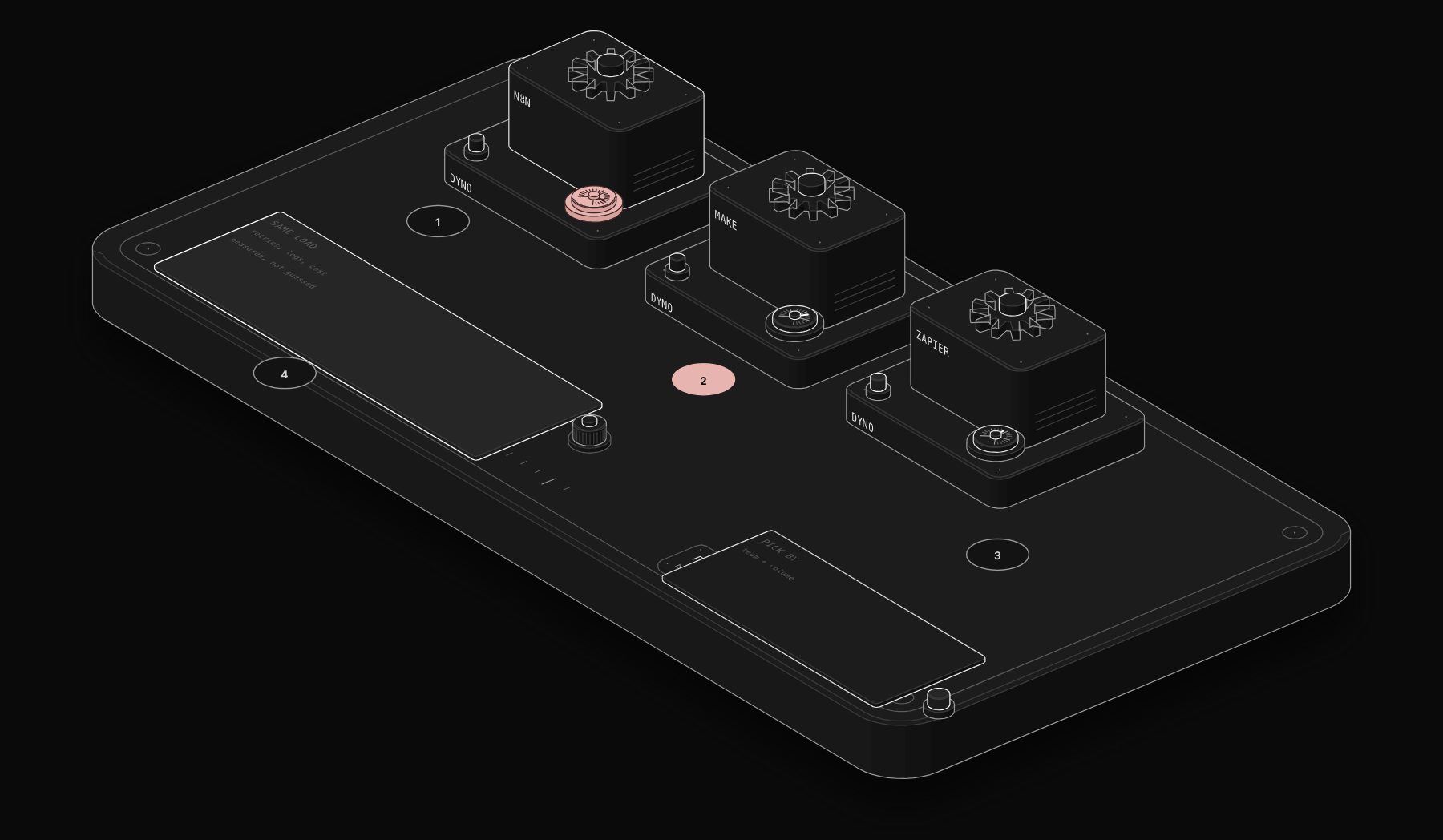
On cost at scale: the comparison changes dramatically depending on volume. At 10,000 monthly operations, Zapier's Professional plan, Make's Core plan, and a self-hosted n8n instance all come in at comparable monthly cost. At 100,000 monthly operations, Make is roughly 40% cheaper than Zapier. At 500,000+ monthly operations, self-hosted n8n has essentially zero marginal cost, you pay for infrastructure (typically $20-80/month for a VPS adequate for most SMB workloads), not operations. For high-volume systems, such as an e-commerce store processing thousands of order events a day or a dental group handling hundreds of appointment events a week, the n8n self-hosted cost model is often the decisive factor.
On customization depth: the ranking is clear and consistent. Zapier handles the most common integrations with the least friction. Make handles complex multi-step logic, array manipulation, and iterative processing with a visual editor that is genuinely capable. n8n handles anything you can write code for, because it has a full JavaScript/Python code node that can execute arbitrary logic inline, connect to any API with custom authentication, and process any data structure. The choice is ultimately a function of your workflow complexity and your team's technical capacity to manage what you build. We build on all three because requirements vary. If forced to pick one for a mid-market SMB with complex requirements and a technical operations team, it would be n8n every time.
This data comes from real production work. If you want the same reliability without hiring an internal team, our n8n automation agency builds these deployments.
Cost at Scale, Modeled
| Monthly operations | Zapier (est.) | Make (est.) | n8n self-hosted (est.) |
|---|---|---|---|
| 10,000 | Comparable across all three | Comparable across all three | Comparable across all three |
| 100,000 | Baseline | ~40% cheaper than Zapier | Infrastructure cost only (~$20-80/mo VPS) |
| 500,000+ | Very high | Meaningfully cheaper than Zapier, still scales with volume | Effectively flat (infrastructure cost doesn't scale with operation count) |
The crossover point matters more than any single price comparison: below roughly 10,000-20,000 monthly operations, the three platforms are close enough in total cost that reliability and ease of use should usually decide the choice. Above that volume, and especially past 100,000 operations, the cost curve diverges sharply enough that platform choice becomes primarily a cost decision for any volume-sensitive operation.
What "Debugging Experience" Actually Looks Like in Each Platform
When a workflow fails in production, the practical difference between these platforms shows up immediately: Zapier surfaces a task-level error notification with a summary message, requiring you to reconstruct the failure context manually from limited information. Make's execution history shows each module's input and output for a given run, letting you trace exactly where a scenario diverged from expected behavior, and its resume-from-module feature avoids re-running an entire scenario after fixing a single step. n8n's execution log goes furthest: full JSON input and output for every node in every execution, configurable per-node error routing, and the ability to manually re-trigger a specific failed execution with edited input data to test a fix before deploying it. For a business running dozens of interdependent production workflows, this debugging depth difference compounds into meaningfully faster incident resolution over time.
Why PURIST Still Deploys All Three
Despite n8n being the default recommendation for technically capable teams with complex requirements, forcing every client onto a single platform ignores real constraints: a client with an existing Zapier investment and simple integration needs gains little from migrating to n8n's added complexity, while a client with sophisticated multi-system logic and a technical operations team would be poorly served by Zapier's branching limitations. The platform choice should follow from the workflow's actual complexity and the client's technical capacity to manage what gets built, not from a blanket platform preference.
Sources & Further Reading
Cost figures reflect public pricing and typical infrastructure costs at the time of writing. For a deeper technical dive specifically on n8n's self-hosted vs cloud tradeoff, see n8n self-hosted vs cloud: the complete decision guide, and for the broader honest comparison written for a general audience, see n8n vs Make vs Zapier: the honest comparison your business actually needs.
Frequently Asked Questions
At what point does self-hosted n8n's infrastructure management burden outweigh its cost savings?
For a business without any internal technical capacity and no budget for a managed service, the operational overhead (security patching, uptime monitoring, backup management) can outweigh the cost savings below a certain automation volume. This is exactly the gap managed n8n hosting (offered by PURIST and similar providers) is built to close, keeping the cost advantage without requiring in-house infrastructure expertise.
Is Make actually more reliable than Zapier, or just more transparent about failures?
Both platforms report comparably high uptime (99.5%+) over extended measurement periods; the meaningful difference is in failure transparency and recovery tooling, not underlying platform reliability.
Can I migrate an existing Zapier setup to n8n without starting from scratch?
The underlying logic (trigger, conditions, actions) needs to be rebuilt in n8n's workflow structure, since the platforms use different execution models; however, understanding your existing Zaps' logic clearly makes the rebuild considerably faster than designing from a blank page.
Does n8n's code node require programming expertise to use?
Basic JavaScript or Python knowledge is genuinely helpful for the code node specifically, though the majority of n8n workflow logic (triggers, standard nodes, conditional branching) requires no coding at all; the code node is there for the minority of cases needing custom logic beyond what visual nodes cover.
How do these three platforms compare on data security and compliance?
All three offer enterprise-tier plans with SOC 2 compliance and data residency options; self-hosted n8n gives the most direct control since data never leaves infrastructure you control, a meaningful factor for businesses in regulated industries with strict data residency requirements.
Tags
Purist Team
The PURIST editorial team covers automation, AI agents, and operations strategy for businesses scaling with n8n, Make, and Claude AI.